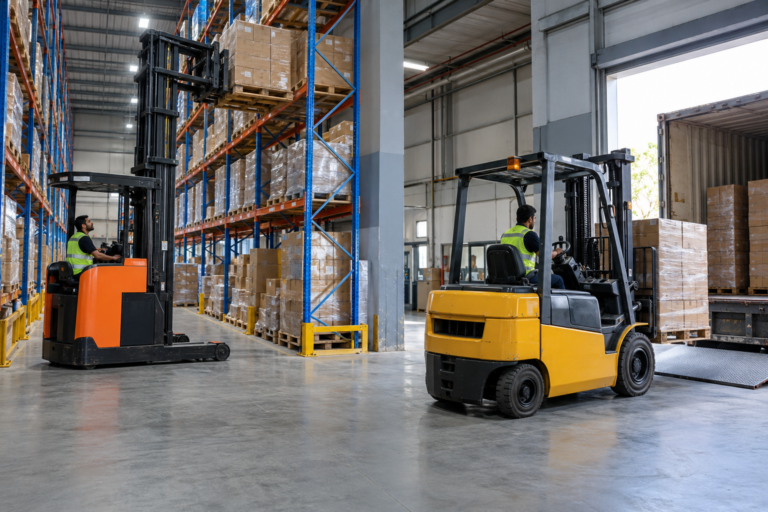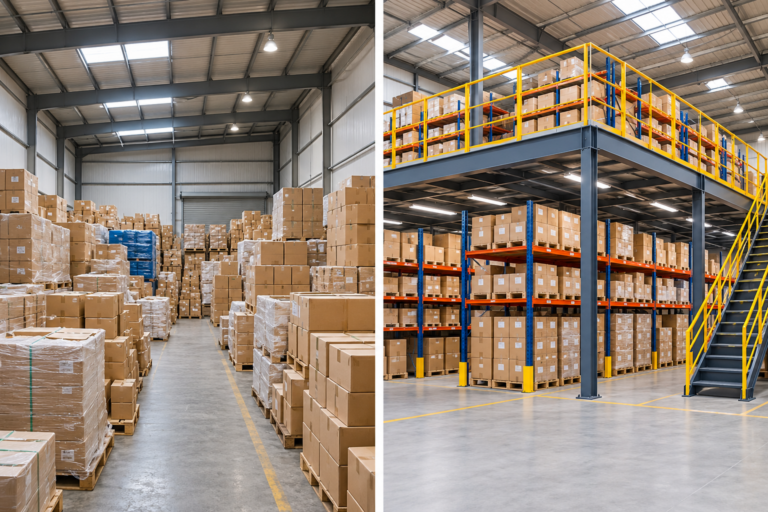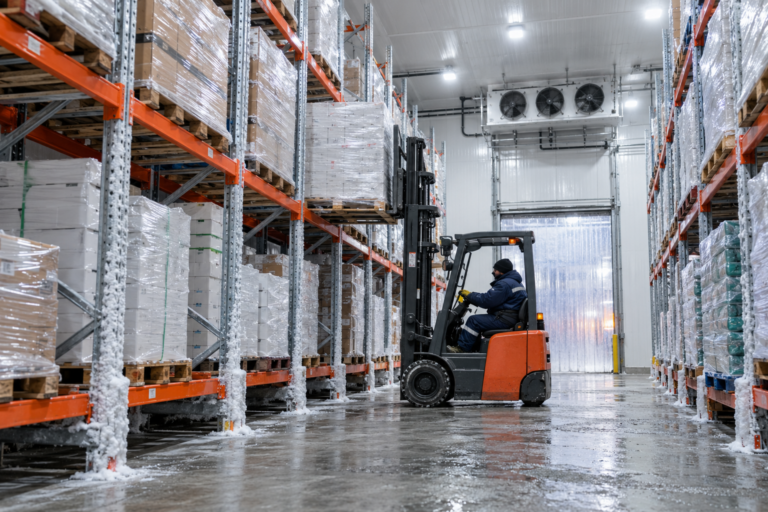
Standard pallet racking is one of the most versatile storage systems in a warehouse until the day you need to store a 6-metre steel pipe, a bundle of reinforcement bars, a roll of sheet metal, or a set of wooden profiles. At that point, the cross-beams and closed bays that make pallet racking so efficient for pallets become the problem. Long items either won’t fit, stick out dangerously over the aisle, or need to be cut to a length that makes no operational sense.
Cantilever racking exists to solve exactly this. It stores long, awkward and heavy materials cleanly, safely and accessibly with no front columns to work around and arms that adjust for different cross-sections and lengths. For the range of configurations, capacities and finishes Reliable manufactures and supplies, see the cantilever racking product range.
This guide covers how a cantilever rack is built, what the key specifications mean, the common configurations, and what you need to know before asking any supplier for a layout.
What is cantilever racking and how is it built?
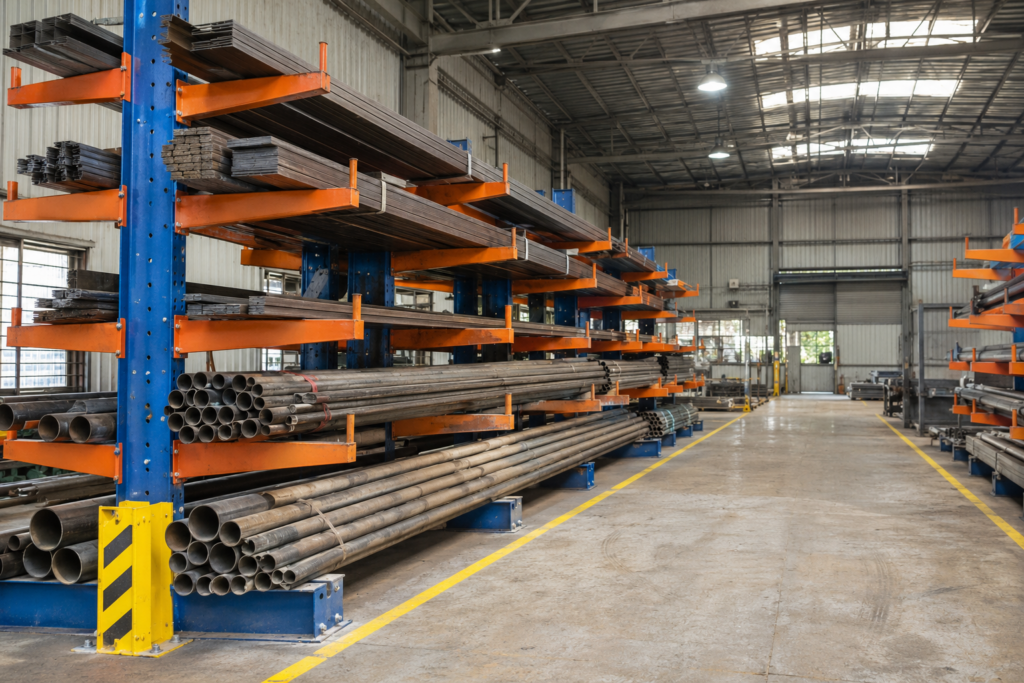
A cantilever rack is a storage system built around vertical columns from which horizontal arms project outward like the arms of a cantilever bridge. There are no front uprights. Nothing blocks access to the stored material from the front. Items of almost any length can be placed on the arms and retrieved without fighting against bay walls or cross-beams.
Every cantilever rack is made up of the same core components:
Upright column the vertical backbone of the system. It carries all the load from the arms above, transferring it down to the floor through the base plate. Columns come in different sections (light, medium, heavy duty) and heights. They have punched slots or holes at regular intervals typically 100–150 mm which allow arm heights to be adjusted as stock sizes change.
Base the horizontal foot of each column. The base must be at least as long as the arm to provide the necessary stability. On outdoor or heavy-duty installations, the base is anchored to the floor slab with bolts, exactly as pallet racking uprights are.
Arms the horizontal projections that carry the load. Each arm is independently rated for the load it can safely carry. The arm capacity is set by the arm’s length, depth (cross-section height), steel grade and how it connects to the column. A longer arm for the same section carries a lower load than a shorter one arm capacity ratings in manufacturer tables vary with length, so always check the specific figure for the arm length being specified, not a general headline capacity.
Bracing horizontal and diagonal members that connect columns within a run, providing lateral stability. Without adequate bracing, a row of columns under load can move sideways. Bracing is always included in a properly designed system and is not optional.
Arm stops short pins or lips at the end of each arm that prevent round or rolling stock (pipes, rods, coils) from sliding off. These are a safety requirement for cylindrical materials, not an optional extra.
Column guards and floor protection base plate protectors and column guards at forklift height. Because cantilever racking is almost always loaded and unloaded with forklifts or overhead cranes handling long items with limited side visibility, impact protection matters more here than in standard pallet racking aisles.
When cantilever racking is the right choice
The primary decision cantilever or pallet racking comes down to the shape and length of what you are storing.
Cantilever racking is the right system for:
- Steel pipes, ERW tubes, seamless pipes and round bar in bundles or individually
- Mild steel flat bars, angles, channels, I-sections and other structural steel profiles
- Sheet metal, plates, coils and rolled stock
- Aluminium extrusions and profiles
- Timber planks, boards and panels
- Furniture frames, sofas and items that are longer than they are wide
- Dies and moulds stored on roll-out arms (discussed below)
- Auto components long shafts, axles, exhaust systems and body panels
The common thread is that these items are long relative to their width and cannot be stacked efficiently on a flat deck without risk of sliding or structural damage.
Pallet racking remains better when:
- Stock is on pallets and can be placed by a standard reach truck or counterbalance forklift
- Items are boxed, bagged or containerised in a form that sits stably on beams
- The inventory requires FIFO rotation with individual position access to each stored unit
Many manufacturing plants use both systems: pallet racking for components and finished goods stored on pallets, and cantilever racking in the material store or cut-to-length area where raw steel, pipe and sections are handled.
Single-sided vs double-sided: which to choose
Single-sided cantilever racking has arms projecting from one face of the column only. It is used against a wall, at the end of a run, or wherever access is needed from one side only. Because the load is applied to one side only, the base and column are designed with an asymmetric loading assumption.
Double-sided cantilever racking has arms projecting from both faces of the same column. It is used in a free-standing run where forklifts can access from either side. The column is loaded from both sides simultaneously, which typically increases the total usable capacity compared with two single-sided runs of the same column height, while using roughly half the floor footprint. For most factory stores with aisle access from both sides, double-sided is the standard choice.
A practical point: on double-sided runs, the loads on both sides should be approximately balanced. Loading one side significantly heavier than the other creates uneven stresses on the base and anchors that the system was not designed for.
Column pitch: the spacing between uprights
Column pitch the horizontal distance between adjacent upright columns in a run is one of the most important specifications to get right. It determines both the storage capacity and the handling practicality of the whole installation.
The column pitch should be set by the length of the longest item being stored. Arms carry loads most efficiently when the load rests on at least two arms, with the arms positioned close to the item’s ends rather than concentrated in the middle. For a 6 m pipe, columns set 2 m apart gives three support points. Columns set 4 m apart leaves the pipe’s mid-section unsupported, which causes deflection (sag) under load.
Beyond sag, widely-spaced columns can leave the tips of long items projecting into the aisle a forklift and personnel hazard. Keep overhangs to a practical minimum.
Too-close column spacing, on the other hand, wastes steel and increases cost. The right pitch is determined by the material’s length and rigidity: rigid structural steel can span further than flexible tubes or timber.
Arm capacity and column capacity: two separate checks
This is where most specification mistakes happen. A cantilever rack has two capacity limits that are separate and both must be respected.
Arm capacity is the maximum load a single arm can safely carry. It is stated by the manufacturer for each combination of arm section and arm length, usually as a uniformly distributed load (UDL) meaning the load should be spread across the arm’s length, not concentrated at its tip. A load placed only at the tip of an arm (tip loading) can reduce the safe capacity by as much as 50% compared with the same load distributed along the arm.
Column capacity is the total load that the upright column can safely carry the combined weight of all the loads on all the arms attached to it. Even if each individual arm is within its rated capacity, adding too many heavily-loaded arms to one column can exceed the column’s total safe load. Column capacity tables from manufacturers always specify the maximum height-to-arm-length ratio as well as the total load.
Both checks must be done. A cantilever system that passes the arm capacity check but fails the column capacity check is not safe.
Roll-out cantilever racking: the option for heavy dies and moulds
Standard cantilever arms are fixed and horizontal. A roll-out cantilever rack adds a telescoping or sliding mechanism to the arm, allowing it to extend outward from the column so that the load can be placed by an overhead crane or hoist and then slid inward to its storage position.
This configuration is specifically used in toolrooms, press shops and injection moulding plants for storing heavy dies, moulds and press tooling. A die weighing several hundred kilograms cannot safely be balanced on a standard fixed arm by a forklift the operator cannot see the alignment from the cab. The roll-out arm brings the storage position to the front of the rack face, the crane lowers the die onto the extended arm, and the arm is then slid back in.
The result is safer handling, faster die changes and significantly less damage to tooling and racks compared with trying to manoeuvre heavy dies into a fixed storage position. See how roll-out cantilever racks are configured for toolroom and press shop applications.
Outdoor cantilever racking: what changes
Cantilever racking is used in outdoor yards steel stockholders, timber merchants, building material stores and pipe distributors frequently store long stock outdoors. For outdoor use, three things change compared with an indoor installation.
Finish. Powder-coated steel is adequate for covered indoor stores. Outdoor exposure particularly in coastal areas, high-humidity environments and near industrial processes calls for hot-dip galvanised steel or at minimum a zinc-phosphate primer with a heavy-coat topcoat. In areas near the coast (including Vasai and the wider Mumbai region), untreated or powder-coated steel in an open yard will show visible rust within months.
Wind loads. An outdoor cantilever rack carrying long, flat-sided stock like sheets or panels presents a significant surface area to wind. The structural design must account for the lateral wind load on the stored material this should be calculated as part of the rack design using IS 875 (Code of Practice for Design Loads) for the specific site location. The engineer designing the rack must know whether the installation is indoor or outdoor before the structure is sized.
Seismic loads. Outdoor installations in seismic zones require design consideration under IS 1893. Maharashtra’s western belt Mumbai, Vasai, Bhiwandi, Pune falls in Zone III. The rack structure and its anchor bolt design need to account for this, especially for taller installations.
Anchor bolts. Outdoor base plates are subject to rainfall and groundwater. The anchor bolt specification and the concrete grade of the slab should be confirmed by a structural engineer before installation.
What to tell your supplier before they design a layout
A cantilever rack layout that has not been designed around your actual materials will either be over-specified (and therefore over-priced) or under-specified (and therefore unsafe). Before contacting any supplier, have these details ready.
The materials you are storing:
- Material type (pipe, bar, sheet, timber, etc.)
- Maximum length of the longest item
- Maximum diameter or cross-section of the largest item
- Maximum weight of the heaviest bundle, item or group that will sit on a single arm
- Whether items are round/cylindrical (which can roll) or flat
How items are loaded and unloaded:
- By forklift (which side, what reach)
- By overhead crane or hoist
- By hand
The handling method directly determines the arm length, the column spacing and whether roll-out arms are needed.
The building or yard:
- Indoor or outdoor?
- Clear height to the lowest obstruction (roof truss, crane beam, sprinkler head)
- Floor slab specification and condition
- Seismic zone (your supplier should know, but confirm it)
Single-sided or double-sided:
- Is the rack going against a wall, or freestanding with aisle access from both sides?
A supplier who quotes without asking most of these questions is guessing at the specification, not designing it.
Cantilever racking and the warehouse aisle
Because cantilever racks store long items and are loaded by forklifts or cranes handling long loads, the aisle in front of a cantilever run must be wider than a standard pallet racking aisle. A forklift carrying a 6 m pipe bundle needs room to approach, align, deposit and withdraw without the load swinging into the rack or the adjacent run.
The required aisle width depends on the longest item being stored, the forklift’s turning radius and the operator’s working comfort. As a starting point, treat the aisle calculation the same way as for pallet racking: use the truck’s Ast (right-angle stacking aisle) figure, adjusted for the actual load length, as covered in the warehouse aisle width guide. For very long loads, a drive-through aisle (where the forklift enters along the run and reverses out) may be more practical than a perpendicular approach.
Multi-tier cantilever racking: using building height
Standard cantilever racking is typically single-tier one set of arms accessed directly from the floor or from ground-level forklift height. In buildings with useful clear height, multi-tier cantilever racking adds walkway levels between the arm tiers, allowing hand-picking of lighter long items from upper levels. This is common in engineering component stores and plumbing or fittings distributors where the ground-level arms carry the heavy pipe bundles and upper levels hold cut lengths, fittings and accessories for manual picking.
Multi-tier designs require careful structural engineering because the walkway loads, guard rail loads and maintenance access loads are all added to the arm loads on the columns.
Frequently asked questions
Can cantilever racking be used for storing sheets and flat material?
Yes. Flat sheets of steel, aluminium, plywood or composite panels are a common cantilever application. For flat-sided sheet material, arm stops are important to prevent sheets from sliding off during loading and unloading. For coils and rolls, inclined arms arms set at a slight downward slope toward the column can be used to keep the coil against the column face rather than the arm tip, improving stability.
What is the difference between light-duty and heavy-duty cantilever racking?
Light-duty cantilever racks are designed for loads up to around 200–500 kg per arm suitable for timber lengths, PVC pipe, aluminium sections and lighter materials typically handled by hand or light equipment. Heavy-duty racks are designed for steel pipe, bar stock, structural steel and other dense, heavy materials typically requiring forklift or crane handling, with arm capacities from several hundred to over a thousand kilograms per arm. The column section, arm section and base size are all different between the two grades. Never substitute a light-duty rack for a heavy-duty application based on appearance alone.
How are cantilever racks anchored to the floor?
Cantilever rack columns are anchored through base plates into the concrete floor slab with chemical or mechanical anchor bolts, the same way pallet racking uprights are. The anchor bolt specification diameter, embedment depth, chemical or expansion type should be provided by the rack manufacturer based on the load and the floor slab specification. Where the floor slab condition is uncertain, a structural engineer should check it before installation.
Can cantilever racking be extended or reconfigured later?
Yes. Additional bays columns and arms can be added to extend a run, provided the new sections are compatible with the existing column series. Arm heights can be adjusted within the column’s punched-slot range. Any extension that adds significant load to an existing base run should be reviewed against the original design, particularly in the context of total column capacity.
Is there a standard colour for cantilever racking in India?
No regulatory colour standard applies. The most common convention in Indian factories is orange arms on blue or grey columns matching the pallet racking industry norm but this is a convention, not a requirement. For stainless steel cantilever racks used in pharma, food processing and coastal outdoor environments, the finish is determined by the corrosion requirement rather than any colour convention.
Planning a cantilever racking layout?
If you store long materials pipes, bars, sections, sheets, timber, dies or moulds and are either setting up a new store or replacing an existing floor-storage arrangement, bring your material dimensions, weights and handling method to the conversation. Reliable Storage Systems designs and manufactures cantilever racking in standard and heavy-duty configurations, with roll-out arm options for toolrooms, multi-tier options for tall buildings, and outdoor galvanised finishes for yards and open stores.
Share your materials and storage requirements →