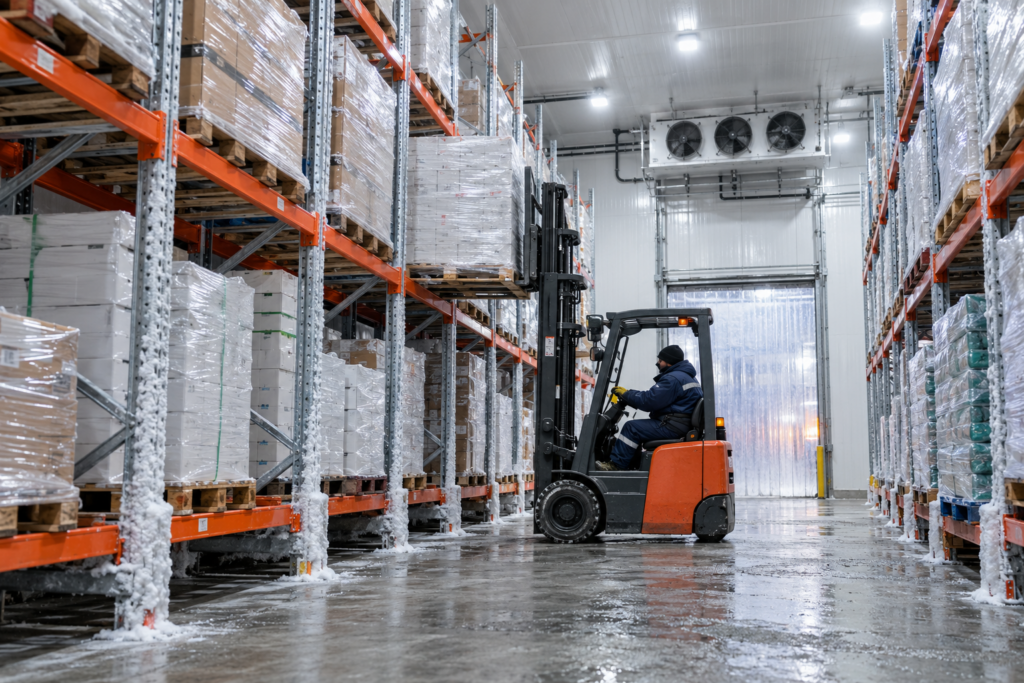
Walk into a cold storage warehouse and the racking looks much the same as anywhere else rows of uprights, beams, pallets. The difference is what those racks are working against. Every hour they sit at −18°C or below, condensation forms, melts and reforms. Forklifts come in from the dock, warm, and go back out cold. Pallets expand and contract with temperature swings. The floor is uneven in ways that only matter when a loaded rack is anchored to it.
Cold storage racking fails for different reasons than ordinary racking, and it costs far more per square metre to replace. Getting it right the first time choosing the correct finish, the right system, and a design that actually suits the product and the truck is not optional. This guide explains what matters and why.
Why cold storage racking is a different problem
In a standard warehouse the biggest risks to racking are forklift impact and overloading. In a cold store those risks still exist, but corrosion and material fatigue join them. Steel expands and contracts as temperatures cycle between the loading dock (+15°C to +25°C) and the cold room (0°C to −30°C). A tall racking structure can move several millimetres over this range, and connections that are tight in a warm shed can loosen in a freezer over time.
Condensation is a constant problem. Every time a door opens, warm humid air enters the cold room, and that moisture settles on metal surfaces. Standard powder-coated racking can handle dry conditions for many years; in a cold store, the paint on chipped or scratched surfaces starts to rust within months.
The other pressure is density. Unlike a dry goods warehouse where aisle space is an acceptable trade-off for flexibility, every cubic metre inside a cold store costs money to refrigerate. Wasted space is wasted energy. That makes high-density storage systems far more attractive in cold chain than they are elsewhere — but those systems have their own requirements.
Materials: the most important choice
The finish on the racking is the first decision, and it is the one most buyers get wrong by defaulting to standard powder-coated steel.
Powder-coated steel
This is the standard for dry warehouses and it works in cold storage only when the coating is properly maintained and undamaged. Any chip, scratch or weld point that breaks the coating becomes a corrosion site within a cold environment. Powder-coated racking is not inherently unsuitable for cold stores, but it demands careful handling during installation and regular inspection afterwards. It is the most economical option and suits chilled (above 0°C) environments where damage risk is managed carefully.
Hot-dip galvanised steel
Galvanisation is the standard finish for serious cold store racking. In the galvanising process, steel components are dipped in molten zinc, which bonds to the steel and forms a corrosion barrier that survives scratches, chips and condensation far better than paint or powder coating. The zinc coating is sacrificial — it corrodes slowly in place of the steel beneath, extending the life of the component significantly.
Hot-dip galvanised racking is specified almost universally for freezer warehouses operating below −5°C, high-humidity environments (seafood, fresh produce), and anywhere that regular hosing-down or washdown is part of the cleaning routine. The upfront cost is higher than powder coating, but the extended service life and reduced maintenance cost typically justify it in cold chain projects.
Stainless steel
Stainless steel is used where the highest hygiene and corrosion resistance is required: pharmaceutical cold rooms, food processing areas with chemical cleaning agents, and cleanroom-adjacent environments. It is more expensive than galvanised steel but easier to clean, resistant to a wider range of chemicals, and does not require zinc coating maintenance. For a cold room that doubles as a production or preparation area, stainless steel is often the only practical option. Stainless steel selective pallet racking is used precisely in these environments.
A simple guide:
| Environment | Recommended finish |
|---|---|
| Chilled (0°C to +5°C), dry product, no washdown | Powder-coated steel (with careful handling) |
| Chilled or frozen (−5°C to −25°C), standard cold store | Hot-dip galvanised steel |
| Frozen below −25°C, high-humidity, seafood/meat | Hot-dip galvanised steel |
| Pharma cold room, food prep, chemical washdown | Stainless steel |
Racking systems for cold storage
Once the finish is settled, the system type comes down to your SKU profile, stock rotation requirements, and throughput — the same questions that apply in any high-density storage decision, but with energy cost as an additional factor.
Selective pallet racking
Selective racking in a cold store is unusual. It gives complete access to every pallet, which is excellent for operations with many SKUs and variable rotation but wide aisles mean a large proportion of the refrigerated floor is used for movement rather than storage. In a cold store, every empty aisle is space you are paying to cool but not filling.
Selective racking is the right choice in cold stores when products vary widely, pallet quantities per SKU are low, or strict FIFO requires individual pallet access. It works best in chilled (rather than deep-freeze) environments or in annexe areas attached to a main high-density block.
Drive-in and drive-through racking
Drive-in and drive-through racking is the most common system in cold stores, precisely because density is everything. Pallets sit on side rails several deep in lanes, and the cold store space between lanes is minimised. The forklift drives into the lane to place and retrieve pallets.
Drive-in (LIFO) is standard for products where rotation order is managed at the batch level rather than the individual pallet level bulk frozen product, ice cream, processed meat, beverages. Drive-through (FIFO) is used where production date matters: ready meals, dairy, fresh produce in a chilled store.
Two things are critical in a cold store drive-in layout. First, pallet quality pallets that sag, warp or break on the side rails can trap a forklift inside the rack. Second, operators must be trained and disciplined about driving speed inside the structure, where clearances are tight and the floor is occasionally icy near the entry.
Radio shuttle racking
Radio shuttle racking is increasingly popular in large cold stores because it eliminates the need for forklifts to drive inside the rack structure. A battery-powered shuttle runs on rails inside the lane, carrying pallets to and from the front. The forklift stays in the aisle. This reduces the risk of rack damage inside a cold environment, and because lanes can be much deeper than drive-in, the density can be higher.
Shuttle systems must be specified for the operating temperature batteries lose capacity in cold conditions, and shuttle electronics need to be rated for the temperature range. A shuttle that is reliable at 0°C may fail at −25°C if not specified correctly. Confirm the operating temperature range in writing with the supplier.
Mobile racking
Mobile racking mounts selective racks on motorised bases that move on rails, collapsing all aisles except the one in use. It offers the highest density of any fully accessible system better than drive-in in terms of accessibility per position and suits chilled environments where throughput is steady and a wide variety of SKUs must be accessed regularly. The motorised drive system needs to be rated for the temperature range, and the floor flatness requirements are higher than for static racking.
Load capacity and floor: the checks that decide the design
Load capacity at temperature
Standard pallet rack design codes do not explicitly reduce capacity for low temperatures, but cold environments add two practical load risks that should be reviewed with the rack manufacturer.
First, ice accumulation. In a poorly ventilated or heavily used cold store, ice can form on pallet surfaces and rack components, adding load above the design weight. Specify and plan the racking with a realistic assessment of the maximum pallet weight including any ice accumulation, not just the product weight.
Second, thermal expansion and contraction. Tall rack frames move as temperature cycles. This is usually managed by design — flexible connections, appropriate anchor bolt sizing — but it means cold store racking should always be designed by someone who understands the thermal environment, not treated as an identical specification to ambient racking.
Floor slabs
Cold store floors are often designed differently from standard warehouse slabs. Insulated floors, underfloor heating systems (to prevent ground heave in deep-freeze stores), and the flatness requirements for very tall racking all interact with the anchor bolt specification. Before finalising the rack layout, confirm:
- The floor slab specification and any thermal protection layers beneath it
- Whether the floor is designed to accept standard anchor bolts or requires specialist fixings
- The floor flatness tolerance, particularly if the layout uses narrow-aisle or shuttle systems
For sites in seismic zones, IS 1893 applies to the rack structure design as it does in any warehouse but the insulated panels and the cold store structure must also be considered as part of the overall load path.
FIFO or LIFO? Why this matters more in cold stores
Stock rotation matters in every warehouse, but in cold chain it has a regulatory and food safety dimension. Expired product or product stored beyond its recommended time at temperature is not just a commercial loss it may be a compliance issue for food businesses and a patient safety issue for pharma cold stores.
Before specifying the racking system, map your rotation requirements by product category:
- Products stored and dispatched in batches of the same SKU with no strict date requirement at the pallet level → drive-in (LIFO) works
- Products where individual pallet rotation must be first-in-first-out → drive-through, FIFO shuttle lanes, or pallet live storage
- Mixed SKU environments with both batch and individual rotation requirements → a combination layout, with FIFO lanes for date-sensitive lines and drive-in blocks for the rest
This mapping directly determines the system layout. Specifying a drive-in system for FIFO-critical product is a common and costly mistake.
Pallet quality and handling equipment
Pallets
Cold stores are hard on pallets. Wooden pallets absorb moisture, warp in freeze-thaw cycles, and can shed debris. A cracked pallet deck over a drive-in side rail is a serious safety risk. If your product is long-term frozen, consider specifying plastic or metal pallets for cold store use, or at minimum inspecting wooden pallets before they enter the store and setting clear rejection criteria.
Stainless steel or galvanised metal pallets are specified for long-term freezer storage and pharmaceutical cold rooms where hygiene and pallet integrity over years of cycling are both requirements.
Handling equipment
The forklift or reach truck used in a cold store must be specified for the operating temperature. Standard electric trucks use lithium-ion or lead-acid batteries whose capacity drops significantly at freezer temperatures. Cold-rated versions are available but must be confirmed against the rack lift heights and aisle widths.
Operators working in cold stores need appropriate protective clothing and thatbulk affects the turning and working-space calculations inside drive-in lanes and aisle widths. Add this to the ergonomic plan at the design stage, not after installation.
Ventilation, sprinklers and racking design
Cold stores with in-rack sprinklers have specific spacing requirements between back-to-back loads typically wider than ambient stores to ensure water flow reaches the product and the structural members. If in-rack sprinklers are part of the fire protection design, confirm the sprinkler consultant’s spacing requirements before finalising beam depths and load configurations.
Refrigeration evaporator units positioned above or between rack runs affect the height available to the top beam level and the air circulation pattern around the product. Include the evaporator positions on the warehouse drawing before the rack layout is finalised.
A checklist before you brief your rack supplier
Before approaching any supplier for a cold store racking layout, have these answers ready:
- Operating temperature — chilled, frozen, or deep frozen (the finish specification depends on this)
- Product range — number of SKUs, pallets per SKU, total positions required
- Rotation requirement — FIFO, LIFO, or mixed, by product line
- Pallet type, size and maximum weight — including ice accumulation allowance where relevant
- Handling equipment — forklift model, cold rating, and available aisle width
- Clear height — to the underside of the lowest obstruction (evaporators, roof trusses, sprinklers)
- Floor specification — slab thickness, insulated floor or standard, underfloor heating if present
- Sprinkler type — in-rack or ceiling-based, and the spacing requirements specified by the fire consultant
A supplier who can quote cold storage racking without asking most of these questions is not designing a system for your cold store they are quoting a standard rack in a different colour.
Frequently asked questions
Does pallet racking need to be galvanised in a cold store?
Not always, but it is strongly recommended for freezer environments (below −5°C) and any cold store with frequent washdown, high humidity, or long-term operation. Powder-coated racking can work in chilled environments if maintained carefully, but galvanised steel lasts significantly longer and requires less maintenance in wet or cold conditions.
Can standard pallet racking be used in a cold store?
Structurally, standard racking can be installed in a cold store, but the finish is unlikely to be appropriate and the design may not account for thermal expansion, cold-rated anchorage or the specific height and clearance constraints of the cold room. Cold store racking should always be designed specifically for that environment, not adapted from an ambient warehouse layout.
Is drive-in or drive-through racking better for cold storage?
Drive-in is more common because density is typically the priority in cold stores. Drive-through is used where FIFO is essential for the product. The choice depends on your stock rotation requirements by product line, not on the cold store itself.
What is the right pallet racking for a pharma cold room?
Pharmaceutical cold rooms typically require stainless steel racking to meet GMP hygiene standards, chemical cleaning agent resistance, and audit compliance. The layout may also need to separate quarantine and released stock zones. See the range of SS pharma storage equipment designed for this environment.
Planning a cold store racking layout?
Cold store racking combines structural design, material specification, stock rotation planning and handling equipment selection into one project. Getting any one of these wrong means expensive changes once the cold room is running.
Reliable Storage Systems designs and manufactures pallet racking in galvanised steel and stainless steel finishes for cold store, food and pharma environments. We also supply the handling equipment forklifts, reach trucks and stackers rated for the temperatures and aisle widths the layout requires, so the rack and the truck are planned as one system.