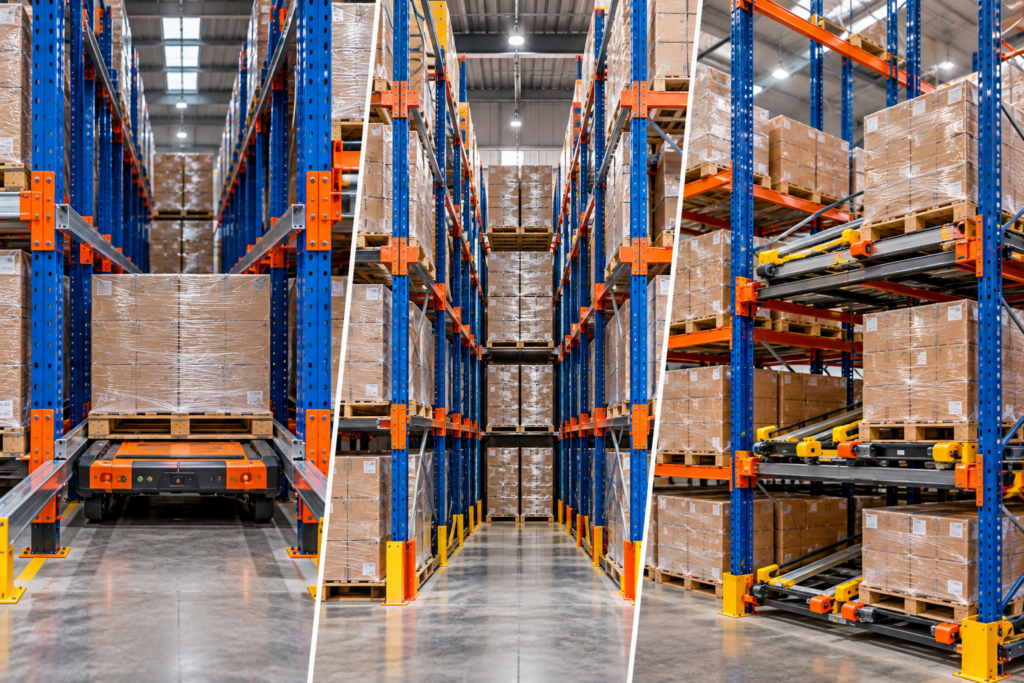
Once a warehouse runs out of floor space, the conversation usually turns to high-density storage: getting rid of some aisles and storing pallets several deep. Three systems come up again and again: drive-in racking, push-back racking and radio shuttle racking.
All three store more pallets in less floor area than standard selective racking. They get there in very different ways, and those differences decide how well each one fits your stock, your trucks and your budget. This guide compares them side by side and ends with a simple way to decide.
First, is high-density storage right for you at all?
High-density systems give up direct access to every pallet in exchange for more positions. That trade only pays off when your stock suits it:
- You hold several pallets of the same product at once, not one or two of many
- Floor space is expensive or limited, such as a cold store, a leased building or a site that can’t expand
- You can live with restricted access, since only the front pallet of a lane (or the back one, for first-in-first-out) is available at any moment
If most of your products have only one or two pallets on hand, standard selective racking usually works better. Our guide on what selective pallet racking is and how to specify it covers that option.
How each system works
Drive-in racking: the forklift goes into the rack
Drive-in racks are built as deep lanes with rails on each side. The forklift drives into the lane and places pallets on the rails, starting at the back and working forward. With one entry side, the last pallet in is the first out (LIFO). Drive-through racks open at both ends, so pallets go in one side and come out the other (FIFO).
One detail is often missed. Because the truck drives along the floor of the lane, the floor-level positions have to be clear before it can reach deeper pallets on the upper levels. In practice the whole lane, top to bottom, behaves as one block, which is why each lane normally holds a single product.
Drive-in racking is the simplest and usually the lowest-cost option per position of the three. It depends heavily on careful driving, because the truck works inside the structure. See how drive-in and drive-through lanes are typically configured.
Push-back racking: pallets ride on carts
Push-back lanes use nested carts on slightly inclined rails. The forklift places the first pallet on the top cart. The next pallet pushes it back one position, and so on. When the front pallet is removed, the ones behind roll gently forward. The system is always LIFO.
The forklift never enters the rack. It works from the aisle, like selective racking. And because each level of each bay is its own lane, you can store a different product on every level. That gives much more SKU flexibility than drive-in.
The limit is depth. Push-back lanes are usually 2 to 6 pallets deep, because each extra pallet needs another cart. See how push-back lanes and carts are arranged.
Radio shuttle racking: a powered carrier does the deep work
In a radio shuttle system, a battery-powered shuttle runs on rails underneath the pallets inside each lane. The forklift places the shuttle in a lane and sets the pallet down at the lane entrance. The operator then uses a remote control to send the shuttle in, and it carries the pallet to the next free position. For retrieval, the shuttle brings pallets forward to the front.
Like push-back, the forklift stays in the aisle, and each level can hold a different product. Unlike push-back, lanes can be much deeper, far beyond what carts or a driving forklift can manage. The system can also be set up for FIFO (load one end, unload the other) or LIFO.
The trade-offs are the shuttles themselves: batteries to charge, a moving machine to maintain, and a need for good-quality pallets that sit correctly on the rails. Throughput also depends on how many shuttles you run, not only on how many forklifts you have. See how radio shuttle lanes, shuttles and charging are planned.
Side-by-side comparison
| Factor | Drive-in / drive-through | Push-back | Radio shuttle |
|---|---|---|---|
| Typical lane depth | Deep, commonly up to around 8–10 pallets | 2–6 pallets | Can be much deeper than both |
| Stock rotation | LIFO (drive-in) / FIFO (drive-through) | LIFO only | LIFO or FIFO |
| Products per lane | One per lane (all levels) | One per level per bay | One per level per lane |
| Forklift enters rack? | Yes | No | No |
| Rack damage risk | Highest | Lower | Lower |
| Moving parts | None | Carts | Shuttles, batteries, chargers |
| Relative cost per position | Usually lowest | Higher | Higher, plus shuttle units |
| Suits | Few products in large batches | Moderate batches of many products | Large batches, deep lanes, cold stores |
These are general patterns from published comparisons, not fixed rules. Actual depths and costs depend on the load, the building and the design.
The questions that actually decide it
1. How many pallets of each product do you hold? This decides the lane depth. If a product usually has 4 pallets on hand, a 10-deep lane will sit partly empty. That wasted space is called honeycombing, and it eats into the density you paid for. Push-back suits small-to-medium batches. Drive-in and shuttle suit larger ones.
2. Do you need FIFO? For dated food, pharma or batch-controlled goods, strict first-in-first-out matters. Push-back can’t do it. Drive-through racking and FIFO shuttle lanes can. If you need FIFO in a short lane, a gravity-fed pallet live storage system is another option to look at.
3. How many different products share the block? Drive-in handles very few products per block well. Push-back and shuttle let each level hold something different, which suits a wider range.
4. How fast do pallets move? In drive-in, every pallet means driving in and out of a lane, which is slower and needs skilled operators. Push-back is quick for shallow lanes. Shuttle throughput can be high, but it depends on the number of shuttles and how the operation is set up.
5. What’s the building like? Cold stores are a common home for all three, because every cubic metre costs money to cool. Shuttle systems specified for low temperatures are widely used there. Clear height, floor quality and column positions affect all three designs.
6. What trucks will you use? All three need the right truck for the lift height and aisle. Drive-in also needs a truck that fits inside the lane with safe side clearance. Our warehouse aisle width guide explains how to match the truck to the layout.
7. What condition are your pallets in? Broken or non-standard pallets cause trouble in every high-density system, but shuttles and push-back carts are the least forgiving. If pallet quality varies, sort that out first.
A simple way to decide
- List your products with the typical and peak pallets held for each.
- Mark the ones that need strict FIFO.
- Group products by batch size:
- Small batches (2–5 pallets), many products → push-back
- Large batches, few products, LIFO fine → drive-in
- Large batches, deep lanes, FIFO needed or high throughput → radio shuttle (or drive-through)
- Put everything with only one or two pallets on hand into selective racking.
- Compare layouts by usable positions after honeycombing, and by total cost, including shuttles, carts, trucks and maintenance.
Many warehouses end up with a mix: a push-back section for medium movers, a shuttle or drive-in block for bulk stock, and selective racking for the long tail.
Frequently asked questions
Which high-density racking gives the most storage?
For very large batches of the same product, radio shuttle and drive-in lanes usually give the most positions, because their lanes can go deepest. The real answer depends on how well lane depth matches your batch sizes.
Is push-back racking FIFO or LIFO?
Push-back is always LIFO. The last pallet loaded is the first one out.
Can radio shuttle racking work in cold storage?
Yes. Cold storage is one of its most common uses, but the shuttle and batteries must be specified for the operating temperature.
Does drive-in racking damage easily?
It is more exposed to damage than the other two, because forklifts drive inside the structure. Operator training, guide rails and regular inspections are important.
Planning high-density storage?
Before choosing a system, gather your product list with pallets per product, your rotation rules, the building drawing and details of the trucks you use or plan to buy. With those, you can compare drive-in, push-back and shuttle layouts on real numbers instead of brochure claims.