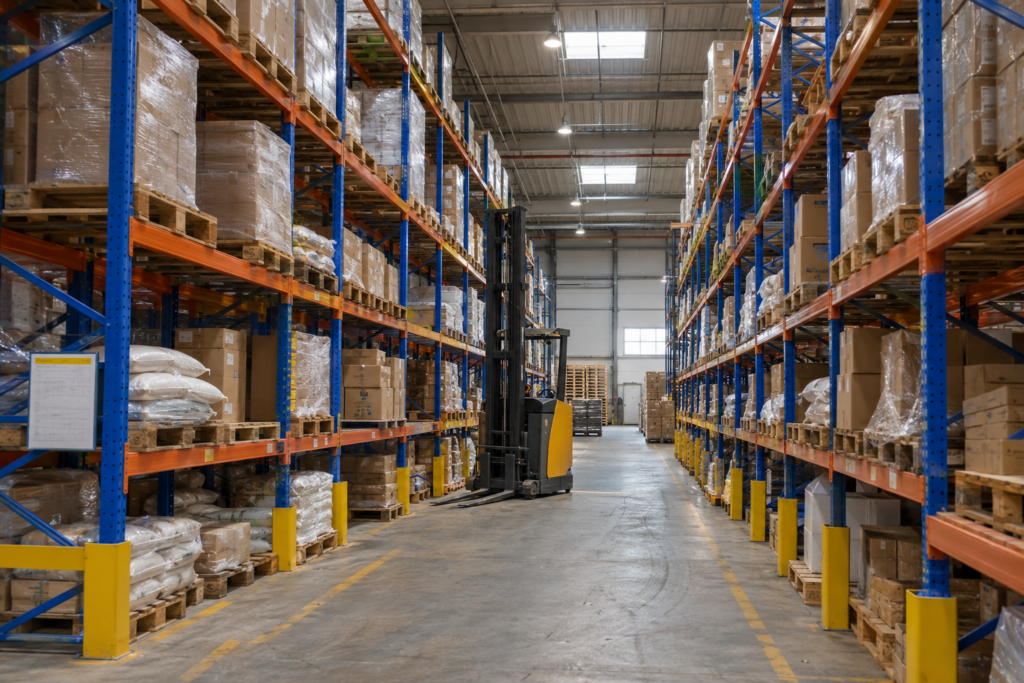
Walk into most warehouses, factory stores and 3PL facilities in India and the racking you see first is almost always selective pallet racking: rows of upright frames connected by horizontal beams, with every pallet sitting in its own slot and facing an aisle. It is the default for a good reason, but “default” does not mean “no thinking required”. The way a selective rack is specified load per level, beam spacing, clearances, aisle width, floor decides whether it runs safely for fifteen years or needs costly changes within two.
This guide explains how selective racking is built, where it works best and where it doesn’t, and what information you should have ready before you ask any supplier for a layout.
What is selective pallet racking?
Selective pallet racking is a static steel storage system where each pallet position can be reached directly from an aisle, without moving any other pallet. That is what “selective” means: you can select any pallet at any time. In the UK and Europe the same system is often called adjustable pallet racking (APR), because the beams can be moved up or down the uprights to suit different load heights.
A single-deep selective layout gives 100% selectivity: every stored pallet is accessible. That is the key trade-off. You get complete access and simple stock rotation, but aisles take up a large share of the floor compared with high-density systems.
How a selective racking system is built
Every selective rack is made up of the same core parts, whoever manufactures it:
- Upright frames – two slotted vertical columns joined by horizontal and diagonal bracing. The frame carries the load down to the floor, and its depth is set by the pallet depth.
- Beams – horizontal members (usually box or step beams) that span between frames and carry the pallets. A beam pair’s capacity is normally stated as a uniformly distributed load (UDL) per level.
- Beam connectors and safety locks – the beam end-plate hooks into the upright slots. A safety pin or lock stops the beam lifting out if a forklift strikes it from below. A missing lock is one of the most common faults found on site.
- Base plates and anchor bolts – they spread the load onto the floor slab and hold the frame in place.
- Row spacers – they tie back-to-back rows together for stability.
- Accessories – pallet support bars, wire mesh or steel decking for loose or undersized loads, column guards, end-of-aisle barriers and load notices showing the permitted load per level and per bay.
If you are comparing quotes, ask each supplier to list these items. Two racks can look identical in a drawing while one leaves out the column protection, safety locks or load signage.
When selective racking is the right choice and when it isn’t
Selective racking works best when you have many SKUs with relatively few pallets each, when stock rotation matters (first-in-first-out for food, pharma or dated goods), or when you pick pallets in no particular order. It works with almost any forklift and is easy to extend or reconfigure as your product mix changes.
It is less efficient when you store a small number of SKUs in large quantities, such as a beverage bottler or a cement bag store. In that case you are paying for an aisle in front of every pallet, even though you only ever need the next pallet of the same product. High-density systems give up some access to gain more storage:
| System | Pallet access | Typical stock rotation | Suits |
|---|---|---|---|
| Selective (single-deep) | Every pallet | FIFO or any order | Many SKUs, mixed movement |
| Double-deep racking | Front pallet of each pair | Mostly LIFO | Two or more pallets per SKU; needs a double-deep reach truck |
| Drive-in / drive-through | First pallet in each lane | LIFO (drive-in) / FIFO (drive-through) | Few SKUs, large quantities, cold storage |
| Push-back racking | Front pallet of each lane | LIFO | Medium quantities per SKU, faster than drive-in |
| Radio shuttle racking | Lane end, served by a shuttle | FIFO or LIFO | High volumes per SKU, fewer truck trips into the rack |
Many warehouses end up with a mix: selective racking for the fast-moving, many-SKU range, and a denser system such as radio shuttle racking for the bulk products. Base the choice on your SKU list, not on how much the layout looks like it will hold.
What your rack supplier needs to know before designing a layout
A reliable layout starts with reliable data. Before you ask for a quote, get these details together. If a supplier quotes without asking for them, treat that as a warning sign.
Pallet size, type and entry direction
Note the pallet dimensions you actually use. 1200 × 1000 mm and 1200 × 800 mm are both common in India, but many plants still run custom wooden pallets. Also note which side the forks enter from. A 1200 × 1000 pallet entering on the 1000 mm face needs a different frame depth and beam length than one entering on the 1200 mm face. Poor-quality or broken pallets may also need extra support bars or decking.
Load per pallet and per level
Give the maximum gross weight of a loaded pallet, not the average. Then be clear about three different numbers that often get confused:
- load per pallet
- load per beam level (usually two or three pallets)
- total load per bay (all levels combined, which the upright frames have to carry)
Beam capacity is quoted per pair at a stated span, and it depends on beam section and span length. Recognised design codes also limit how far a beam may bend under load: EN 15512 uses a span/200 deflection limit. So a beam can be strong enough and still bend more than the code allows.
Beam spacing changes upright capacity
This point is often missed. An upright frame does not have one fixed capacity. The further apart the beam levels are, and the higher the first beam sits above the floor, the less load the frame can safely carry, because beams also act as ties that stop the uprights buckling. If you later remove a beam level to fit taller loads, the frame’s capacity can drop even though the total weight hasn’t changed. Any change to beam heights should be checked against the manufacturer’s capacity data before it is made.
Clearances around each pallet
Pallets need working room to be placed without hitting the rack. The SEMA code of practice used in the UK gives typical figures. For beam levels between 3 m and 6 m high, it gives about 75 mm side clearance between pallets and between pallet and upright, about 100 mm vertical clearance above the load, and about 50 mm pallet overhang at the front and rear beams. Clearances increase at greater heights. Where in-rack sprinklers are fitted, the gap between back-to-back loads is usually wider. Treat these as reference values; your designer should confirm them for your truck, height and operators.
Building height, floor and location
Note the clear height to the lowest obstruction (roof truss, lights, sprinkler heads, ducting), not just the roof height. Tall selective racks put heavy point loads through each base plate. Ask a structural engineer to check that your floor slab’s thickness and concrete grade can take those loads and hold the anchors. For taller or heavily loaded racks, the design should also account for your site’s seismic zone under IS 1893.
Aisle width and the truck you will use
The rack layout and the truck have to be designed together. Aisle width comes from the truck’s right-angle stacking aisle figure (often shown as Ast on the manufacturer’s datasheet) plus a working margin. Get this figure from the truck’s datasheet, not from a general rule of thumb.
- Counterbalance forklifts need the widest aisles but work well for mixed indoor–outdoor use.
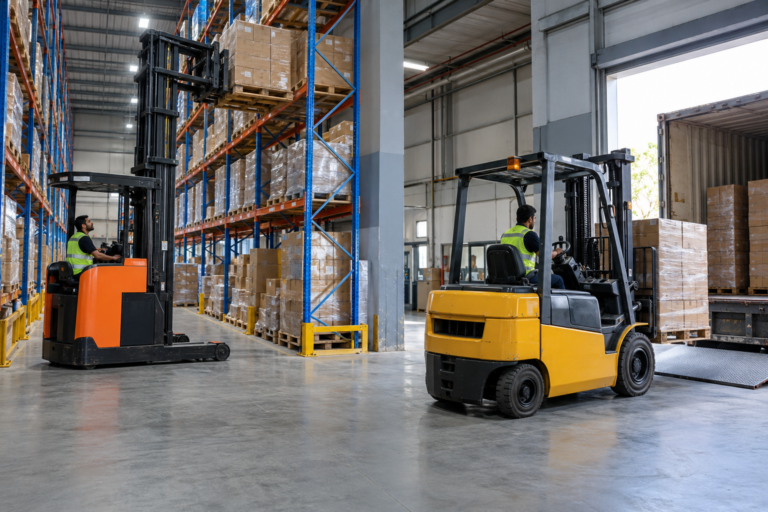
- Reach trucks work in narrower aisles and lift higher, which is why they are common in racked warehouses.
- Narrow aisle trucks allow the tightest layouts, but usually need a very flat floor and guided aisles.
Switching trucks after the rack is installed often means moving the whole rack. If you are buying both at once, plan them as one project.
Choosing the finish
Most selective racks are powder coated, which suits dry, covered warehouses. Galvanised components are worth considering for high-humidity sites, semi-open areas and cold rooms, where coated steel may corrode faster. For pharma, food processing or washdown areas, stainless steel selective pallet racking avoids the problem of chipped paint and is easier to clean. The right choice depends on the site’s conditions, not on price alone.
Keeping selective racking safe after installation
Most racking failures come from how the rack is used, not how it was designed. A few habits make a large difference:
- Display load notices on every run and make sure supervisors and operators know what they mean.
- Never move beam levels without checking the new configuration against the supplier’s capacity data.
- Report damage immediately. A bent upright at forklift height can reduce capacity sharply. Damaged uprights should be replaced, not hammered straight.
- Check safety locks and anchors during routine walk-rounds.
- Schedule periodic inspections by a competent person. Many warehouses use EN 15635 as their reference: it combines daily visual checks with at least one expert inspection a year, and uses a green/amber/red scale to decide what needs action.
Frequently asked questions
Is selective pallet racking the same as heavy-duty racking?
Not exactly. “Heavy-duty racking” describes how much load a rack is built for, while “selective” describes how pallets are accessed. Most selective pallet racks are heavy-duty systems, but capacity depends on the beam and frame sections chosen for your loads.
How much weight can a selective pallet rack hold?
There isn’t one standard figure. Capacity depends on beam section and span, frame section, beam spacing, the height of the first beam level and the floor. Always use the load stated for your specific configuration on the supplier’s drawing and load notice.
Can selective racking be reconfigured later?
Yes, that is one of its main advantages. Beams can be moved and bays added. But every change to beam heights or loads should be rechecked against capacity data, because the safe load on the frames can change.
What is the difference between single-deep and double-deep selective racking?
Single-deep racking gives direct access to every pallet. Double-deep places two pallets one behind the other, which cuts the number of aisles but means only the front pallet is directly reachable. It also needs a double-deep reach truck with extended forks. See how double-deep pallet racking is laid out.
Planning a new racking layout?
If you are setting up a new warehouse or re-racking an existing one, start with your pallet data, SKU profile and building drawings. Reliable supplies both the racking and the forklifts, reach trucks and stackers that work with it, so the rack and the truck can be planned together. You can review the frame sizes, beam options and finishes of our selective pallet racking before you get in touch.