Every warehouse owner wants to store more, move faster, and keep operations running without a hitch. But none of that matters if your racking system can’t handle the weight you put on it.
Before you invest in any storage system, you need to calculate load capacity accurately. Skipping this step is one of the most common — and most dangerous – mistakes businesses make. A rack that looks sturdy on paper can fail badly if the numbers weren’t worked out properly in the first place.
In this guide, we’ll walk you through why load capacity matters, what affects it, and how to calculate load capacity step by step, so your storage system stays safe for years to come.
Why Load Capacity Matters in Industrial Storage
Load capacity isn’t just a technical detail — it’s the foundation of warehouse safety. Every rack, beam, and upright is designed to hold a specific maximum weight, and going beyond that limit puts your goods, your equipment, and your workers at risk.
Overloaded racks can bend, buckle, or collapse without warning. Even a small miscalculation can lead to product damage, costly downtime, or serious injury on the floor.
That’s why businesses that plan to calculate load capacity before installation avoid these risks entirely. It’s a small step upfront that saves a lot of trouble later.
Factors That Affect Load Capacity
Several variables come together to determine how much weight a rack can safely carry. Understanding each one helps you make smarter storage decisions.
Weight of Stored Goods
The type of inventory you store — whether it’s raw materials, finished goods, or heavy machinery parts — directly affects the load your rack needs to bear. Dense or irregularly shaped items often need extra consideration.
Rack Dimensions
Taller racks, wider bays, and longer beam spans change how weight is distributed across the structure. Larger dimensions usually mean the load-bearing design needs to be more precise.
Beam Capacity
Beams support the pallets and goods placed on each level. Every beam has a rated capacity, and using one that’s undersized for your load is a common cause of rack failure.
Upright Frame Strength
The vertical frames carry the combined weight of every level above them. Their strength depends on the steel gauge, frame design, and how well they’re anchored to the floor.
Floor Load Rating
Even the strongest rack won’t help if your warehouse floor can’t support the combined weight of the rack and its contents. Floor load rating is often overlooked but just as important as the rack’s own capacity.
Step-by-Step Guide to Calculate Load Capacity
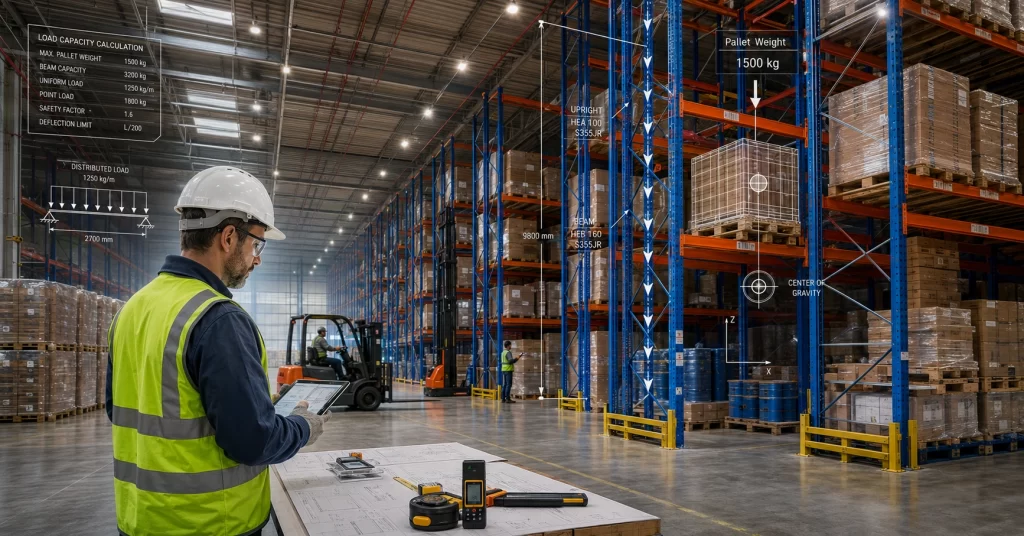
Here’s a practical approach to help you calculate load capacity before installation begins.
1. Determine product weight Start by identifying the average and maximum weight of the items you’ll be storing. Don’t rely on estimates — actual weights give you a much more reliable base for calculation.
2. Calculate pallet weight Add the weight of the pallet itself to the goods it carries. This combined figure is what the rack actually needs to support, not just the product weight alone.
3. Understand beam capacity Check the manufacturer’s rated beam capacity and compare it against your calculated pallet weight. Always leave room between the two figures rather than cutting it close.
4. Understand upright capacity Multiply the weight per level by the number of levels to get the total load on each upright frame. This tells you whether your frame design can handle the full stack.
5. Distribute weight evenly Uneven loading puts extra stress on specific points of the rack. Spread weight evenly across each pallet position to keep the structure balanced and stable.
6. Leave safety margin Never design a system to run exactly at its maximum rated capacity. A safety margin — typically recommended by your manufacturer — accounts for real-world variables like handling errors or uneven pallets.
Common Mistakes to Avoid
Many businesses run into trouble simply because they skip proper planning. Here are mistakes worth watching out for:
- Estimating product weight instead of measuring it
- Ignoring the combined weight of pallets and goods
- Overlooking floor load rating during installation
- Loading racks unevenly across bays
- Not leaving any safety margin above expected loads
- Choosing racks based on price alone instead of engineered capacity
Avoiding these errors early on makes a real difference to how long your storage system lasts and how safely it performs.
Benefits of Choosing Reliable Storage Systems
Working with the right partner takes the guesswork out of this entire process. Reliable Storage Systems designs every Heavy Duty Pallet Rack around your actual load requirements, not generic assumptions.
Our engineering team calculates beam capacity, upright strength, and floor load compatibility before a single rack is manufactured. As a trusted name in heavy duty industrial storage racks, we make sure every system we install is built to perform safely under real warehouse conditions – not just look good on a spec sheet.
Why Work with Experienced Manufacturers
Load capacity calculations aren’t something to leave to guesswork or generic templates. Experienced industrial storage racks manufacturers understand how different steel grades, welding standards, and design configurations affect real-world performance.
Choosing seasoned industrial racks manufacturers means your storage system is backed by years of engineering knowledge, tested designs, and a proven track record — giving you confidence that your investment will hold up under daily operational stress.
Conclusion
Getting your racking system right starts with one essential step: you need to calculate load capacity before anything is installed. From product weight to floor load rating, every factor plays a role in keeping your warehouse safe and efficient.
Skipping this step might save time upfront, but it puts your inventory, equipment, and people at unnecessary risk. Taking a careful, calculated approach protects your business in the long run.
Ready to design a storage system built around your actual load requirements? Contact Reliable Storage Systems today for expert guidance on selecting the right Heavy Duty Pallet Rack and heavy duty industrial storage racks — engineered to perform safely, every single time.
Frequently Asked Questions
Q1. Why is it important to calculate load capacity before installing racks? Calculating load capacity ensures your racking system can safely hold your inventory without risk of bending, buckling, or collapse. It protects your goods, equipment, and warehouse staff while helping the structure last much longer under daily use.
Q2. What factors affect rack load capacity? Rack load capacity depends on the weight of stored goods, rack dimensions, beam capacity, upright frame strength, and floor load rating. Each of these factors works together to determine how much weight a system can safely support.
Q3. Can a Heavy Duty Pallet Rack store different pallet weights? Yes, a Heavy Duty Pallet Rack can be engineered to handle varying pallet weights, provided the beam and upright capacities are calculated correctly for the heaviest expected load, along with an appropriate safety margin.
Q4. Why should businesses choose experienced industrial storage racks manufacturers? Experienced industrial storage racks manufacturers bring tested engineering knowledge, proper material selection, and accurate load calculations to every project, reducing the risk of structural failure and ensuring long-term safety and performance.
Q5. How can Reliable Storage Systems help select the right storage rack? Reliable Storage Systems assesses your product weight, warehouse layout, and floor conditions to recommend the right heavy duty industrial storage racks. Our team handles the calculations so you get a system built specifically for your operational needs.